
Why Audience Strategy Matters More in the Age of AI

A few years ago, a family planning a vacation in Maine might have spent an evening clicking through articles about coastal towns, lobster shacks, and things to do with kids in Acadia National Park. Today, Google can put together a detailed itinerary without anyone clicking on a single travel article.
That’s convenient for the family. But for the tourism organization that spent time and money putting together a guide to the Maine coast, it raises an uncomfortable question: Who’s going to read it?
The time to figure out how that guide will find its readers is before anyone starts writing it.
Great Content Doesn’t Guarantee an Audience
In 2025, Pew Research Center put some numbers to this problem. An analysis of Google search activity found that users clicked on a traditional search result in just 8% of visits when an AI summary appeared, compared with 15% when it didn’t. Even appearing in an AI summary is no guarantee of traffic: Users clicked on links within the summaries in just 1% of visits featuring one.[i]
This doesn’t mean that search engine optimization is a waste of time, but a content strategy that depends almost entirely on organic search puts an awful lot of faith in a system over which marketers have very little control.
Knowing a great deal about an audience doesn’t necessarily mean having a reliable way to reach it. For years, organic search helped bridge that gap. Now, “they’ll find us on Google” is looking less and less like a distribution strategy.
Where Audiences Go for Information Still Matters
An AI-generated answer might be perfectly adequate for someone trying to convert tablespoons to ounces. But convenience isn’t always the deciding factor when people are looking for information. Someone trying to find out why the city council voted to close their neighborhood library might want to know where that information came from.
In its 2025 Generative AI and News Report, the Reuters Institute found that only 12% of people surveyed across six countries were comfortable with news coverage generated entirely by AI.[ii]
An established local newspaper has an advantage here. It has readers who know it by name, who have followed its coverage of their community for years and who know where to turn when something happens close to home.
For marketers, publishing branded content through an established news outlet offers an opportunity to reach an audience that already exists, in a setting familiar to those readers.
Put the Audience at the Center of the Plan
Suppose an article about buying your first home draws 20,000 readers from across the country. If the advertiser is a regional bank that lends in three states, how many of those readers are prospective customers?
That’s the sort of question that ought to come up in the planning meeting, not when the campaign results come in. Before developing a story, get specific about the people you want to reach. Where do they already go for information? Once they’ve read your story, what would you like them to do?

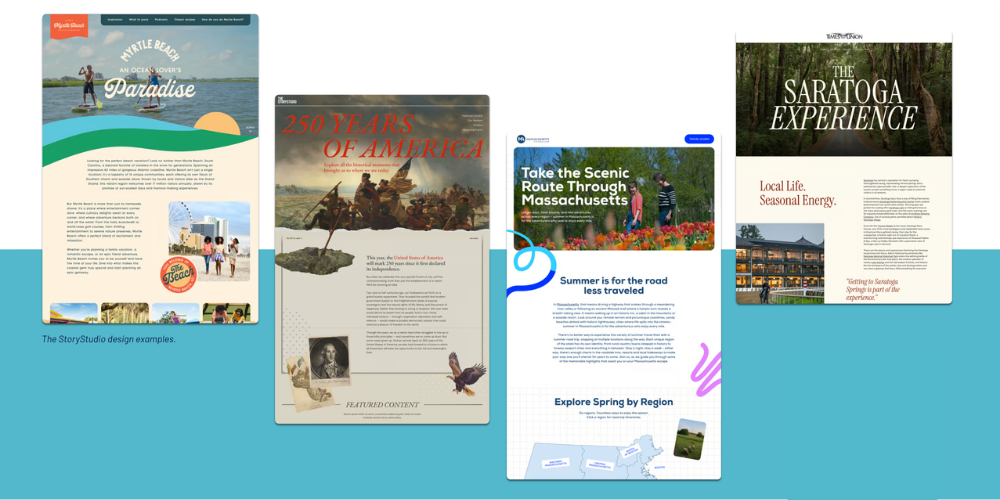
StoryStudio has the advantage of Hearst’s established readership and first-party audience insights to help answer those questions. We combine branded content with guaranteed, targeted distribution, giving marketers a way to reach their intended audiences without leaving discovery to chance.
That same thinking should inform how you measure a campaign’s success. For our hypothetical bank, a reader who goes on to explore its mortgage options may be considerably more valuable than a dozen readers who simply click on the story.
Planning for a Changing Search Landscape
Two years from now, searching for something online may be a very different experience than it is today. A good audience strategy gives marketers a degree of independence from all that change. Knowing who they need to reach and having a reliable plan for reaching them will remain fundamental to effective content marketing.
Want to talk about getting your next story in front of the right readers? Email StoryStudio@Hearst.com or visit hearststorystudio.com.
[i] Athena Chapekis andAnna Lieb, “Google Users Are Less Likely to Click on Links When an AISummary Appears in the Results,” Pew Research Center, July 22, 2025.
https://www.pewresearch.org/short-reads/2025/07/22/google-users-are-less-likely-to-click-on-links-when-an-ai-summary-appears-in-the-results/
[ii] Felix Simon, Rasmus Kleis Nielsen, and Richard Fletcher, “Generative AI and News Report 2025: How People Think About AI’s Role in Journalism and Society,” Reuters Institute for theStudy of Journalism, October 7, 2025.
https://reutersinstitute.politics.ox.ac.uk/generative-ai-and-news-report-2025-how-people-think-about-ais-role-journalism-and-society
you might also like:
Why Audience Strategy Matters More in the Age of AI

The Currency of Attention: What Readers Really Value

Taking Visibility to the Next Level: Diversifying Products to Social, Podcasting, and AI
In the Age of AI, Human Voice Is the Advantage